Parrot Fish: The Price of Consumption
over Conservation
 |
It’s not a well-kept secret, if a
secret at all, to say that the coral reefs of Jamaica are
in a very bad shape. The current situation of Jamaica’s
reef tells a story of thick algae mats that smother and
limit the growth of many organisms, particularly corals.
Corals and algae depend on a similar resource to grow –
sunlight – and through photosynthesis the production of
food and growth can occur. However, corals and algae are
not similar in the speed in which they grow, with some
corals growing as much as a few centimetres in dimension
per year.
As such, Jamaica has seen a massive shift in reef
dominance. Areas that were once dominated by beautiful and
intriguing coral species in the early 70’s are now plagued
with non-appealing green thickets of algae that limit a
reef’s inherent growth.
No corals equal no growth.
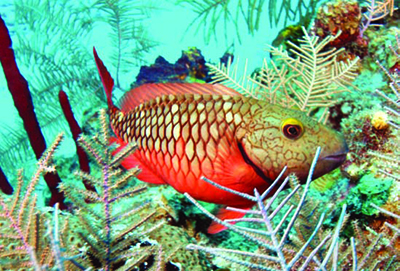
The parrotfish is one of the last remaining defences
against total algal take-over. Being a key herbivore,
parrotfish are typically credited for using their
beak-like mouths to scrape and consume algae that are
usually associated with coral reefs. This scraping
mechanism is also important, as the gathering of excess
rubble in their stomachs is broken down and churned out as
sand particles.
Parrotfish are therefore credited with contributing to
sand creation and ultimately beach sand creation. It has
been proved that an adult parrotfish has the ability to
create 800pounds of sand in a year.
At the same time, however, this same parrotfish is one of
the most sought after commercial fish in Jamaica. Many
locals highlight it as their personal favourite fish to
consume. That demand has led to fishermen being encouraged
to provide a continuous supply of the parrotfish, even
catching them at the juvenile stages. This has proven to
be further deleterious for coral reefs as added human
pressures have drastically decreased the population of
adult parrotfish, leading to lowered chances of the reefs
reviving from algal domination.
The resulting dilemma is that the parrotfish is seen not
only as an important resource to the health and growth of
coral reef systems but also as an important resource for
revenue generation for many communities across the island.
It is also an important variable that will determine the
long term impacts on Jamaica’s tourism sector and other
industries that benefit from Eco-Tourism and marine
services.
It is against this background that The UWI, Mona Campus
and Sandals Resorts International have entered into a
partnership agreement aimed at producing “convincing data”
to support calls for parrotfish management systems in the
island.
The first stage of research will involve scoping the sites
that will become permanent study sites. The intention is
to deploy unmanned cameras, and also carry out parrotfish
in-water surveys and reef assessments. A four-man UWI
team, led by marine biologist Dr. Dayne Buddo, Assistant
Director at The UWI's Centre for Marine Sciences, has
already done two preliminary dives in the Negril and
Whitehouse regions.
The UWI will further conduct island wide in-water surveys to retrieve
information on the diversity, density, abundance and
biomass of the parrotfish species. The team will also
visit fishing beaches to study the characteristics of the
parrotfish being caught and will also conduct a
socioeconomic assessment for fishing communities, many of
which depend on the parrotfish to sustain their
livelihoods.
This research intends to highlight the actual relationship
between the present parrotfish species fish stock and the
effects of fishing of the species in Jamaica. The data to
be collated is Jamaica’s first pool of information to
compare to works by Bozec (2016) that identified the
specific size range of parrotfish to be fished without
ecological collapse.
Furthermore, the research intends to highlight the true
economic value of parrotfish to Jamaica. Using data
collected from the direct and indirect beneficiaries of
marine services and equating this to the market value of
parrotfish per pound, a true value of parrotfish to the
locals of Jamaica will be gathered to understand whether
it is more costly, in Jamaican dollars, to continuously
fish and sell parrotfish on the local market as a food
commodity, or conserve the fish and reap the per pound per
dollar benefit through increased means of Eco-Tourism and
Ecological services the fish provides.
The Sandals Resorts International has kindly contributed
to the implementation of the research project by providing
accommodation and diving facilities at their resorts for
the research team. In addition, they have provided cash
sponsorship, which helps to offset transportation for the
team, as the purchase of some underwater equipment.
The findings of the study will be used to guide the
Government of Jamaica to appropriately manage the species,
to ensure the long-term recovery and sustainability of the
species in Jamaica. |