



The Climate Finance Access Network (CFAN), in partnership with The University of the West Indies through the Faculty of Science and Technology’s Climate Studies Group Mona and the Mona Academy of Science and Technology (MAST) at the Mona (Jamaica) and Cave Hill (Barbados) campuses , as well as the Planning Institute of Jamaica, successfully hosted a Hybrid Climate Finance Training Programme from March 17–19, 2026.
The programme brought together participants from twenty-three (23) Caribbean countries, affiriming the region’s growing commitment to strengthening climate resilience and expanding access to sustainable finance opportunities.
The three-day training engaged more than 200 virtual participants, alongside forty-nine (49) in-person attendees across both campuses - thirty (30) participants at the Mona Campus and nineteen (19) participants at the Cave Hill Campus.
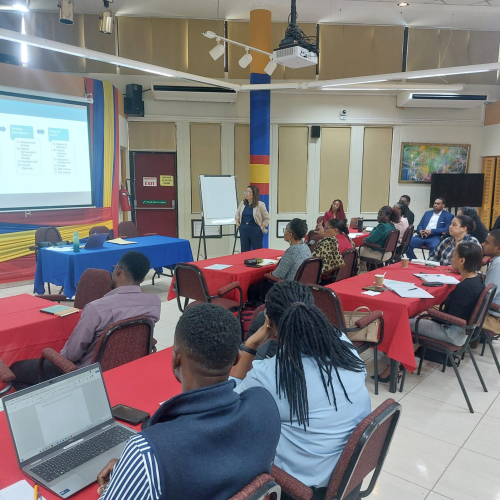

Photo caption: Participants at the CFAN Workshop hosted on March 19, 2026 at The UWI Mona Campus.
Presentations were delivered by Shalenie Madho of the Climate Finance Access Network, Nicholas Fields, Advisor at the CARICOM Development Fund (CDF), Chemora McKnee, Advisor for Special Projects at the CARICOM Development Fund with remarks from Professor Sandrea Maynard, Pro Vice-Chancellor of Global Affairs at The University of the West Indies. The presenters shared expert insights on climate finance systems, project preparation, and regional opportunities for funding access.
The training programme explored several key areas, including the global and regional climate finance landscape, with specific emphasis on accessing major multilateral funding mechanisms such as the Green Climate Fund (GCF), the Global Environment Facility (GEF), and the Adaptation Fund.
Participants also received practical guidance on climate project development and proposal design across the full project cycle. Sessions focused on the use of tools and methodologies to transform climate concepts into bankable and investment-ready projects capable of attracting international financing support.
A major feature of the programme was the incorporation of applied learning exercises and case studies drawn from successful multilateral climate fund concept notes. Participants collaborated in hands-on exercises based on real-life Caribbean climate finance scenarios, allowing them to strengthen practical skills in project formulation, stakeholder engagement, and funding proposal development.
The training initiative underscored the importance of regional collaboration and knowledge sharing in advancing climate action across the Caribbean, while building the technical capacity needed to access and effectively manage climate finance resources critical to sustainable development and resilience-building efforts.
Published on 22 May, 2026

Our 7 faculties and 12 professional schools offer more than 200 programmes to some 18,000 graduate, undergraduate and continuing studies students.
The UWI, Mona ranks first in Jamaica among accredited tertiary-level programmes. In 2012, the University was again one of Jamaica’s Top 100 Employers.
© Copyright 2014-2026 | Disclaimer | Privacy Statement