


Melissa Curtis has recently completed her PhD in Geology, with a research title of “Water Resources Assessment of the Upper and Lower Rio Cobre Watershed Management Units, using a suite of hydrological modelling tools”. Her research is particularly relevant given the ongoing impact of climate change, and reflects her passion for water management, hydrology, and environmental sustainability in Jamaica and other Small Island Developing States.
Under the supervision of Dr Arpita Mandal (Senior Lecturer @uwigeoggeol), Curtis built on her academic foundation, which includes a Bachelor of Science in Geology (major) and Geography (minor) from The UWI, Mona, and MPhil research begun in 2016. As a graduate student (with the keen guidance of her supervisor), she contributed to the State of the Jamaican Climate 2022 report, Vulnerability Risk Assessment and Climate Change Adaptation for the Water Sector.
Curtis has presented her research at various international conferences, including the Geological Society of America Conference (2017), Caribbean Water and Wastewater Association Conference (2018), ESRI User Conference (2019), and the Global Water Partnership Caribbean Conference (2021). Her work has also taken her to countries like St. Kitts, Barbados, Belize, and Guyana, where she assisted in training sessions on hydrological and hydraulic modelling tools. Locally, she worked on projects such as the Hope/Yallahs watershed and the Sediment Budget Projects in the Rio Minho.
Melissa's contributions to the field have earned her recognition, including the ESRI Young Scholar award in 2019 for her application of GIS in research. Her latest publication is a book chapter titled “Potential of flood modelling for forecasting of floods in the data-poor environment: case studies from Jamaica” (2024).
Originally published on the FST website on 21 Jan, 2026

Jevon Forrest is a proud graduate of the Faculty of Science and Technology, earning a BSc in Geography with a minor in Information Technology from The University of the West Indies, Mona.
He began his academic journey in September 2019 as a part-time student, balancing full-time work while self-financing his education. In 2025, he graduated with First Class Honours, earning several Academic Commendations along the way.
Beyond academics, Jevon remained actively engaged in faculty life. He served as 2nd Vice President of the Computing Society and later as Senior Content Creator on FST’s Publications Subcommittee. Working alongside fellow creatives, he helped redesign departmental logos, contributing to a refreshed visual identity and renewed sense of excellence across the faculty. His creative contributions also supported a successful FST campaign that culminated in the election of a UWI Mona Guild President.
Jevon’s path was not without challenges. He stepped away from his studies during the COVID-19 pandemic and after the loss of his beloved grandmother. Despite these setbacks, his resilience and determination carried him through to completion.
Academically, Jevon demonstrated a strong interest in meteorology and Geographic Information Systems (GIS). His scholarly work extended beyond the classroom, with a publication in the Caribbean Geoscience Conference Volume of Abstracts, based on collaborative coursework completed with his classmates—marking an important milestone in his academic and research journey.
He further strengthened his technical expertise by earning official GIS certification through UWI in partnership with the Land Information Council of Jamaica and the National Spatial Data Management Branch. During his internship at the International Centre for Environmental and Nuclear Sciences (ICENS), he applied these skills to support carbon accounting and environmental research, producing key spatial maps.
Committed to professional development and national impact, Jevon also completed the Supervisory Management course at the Mona School of Business.
Originally published on the FST Website on 16 Jan, 2026.

Dr. Rose-Ann Smith (Department of Geography & Geology) and Dr. Jhordanne Jones (Department of Physics) recently attended the First Lead Author Meeting (LAM1) for the IPCC 7th Assessment Report, held in Paris from December 1–6, 2025.
Dr. Smith serves as Lead Author for Chapter 18: Adaptation of Human Settlements, Infrastructure and Human Systems in Working Group II, while Dr. Jones is Lead Author for Chapter 3: Changes in Regional Climate and their Causes in Working Group I.
Also among the Lead Authors was Dr. Kevon Rhiney, an alum (and former lecturer) from the Department of Geography and Geology.
Drs. Smith and Jones described the week as intense, educational, and highly informative, offering exceptional opportunities for collaboration and networking with leading scientists from around the world.
Originally published on the FST website on 08 Dec, 2025.

The Youth Environment Assembly (YEA) 2025 hosted a side event titled GEO-7 Explained: Insights for Youth from UNEP’s Flagship Assessment on November 30, 2025 at UNEP Headquarters, Nairobi. The session aimed to engage young changemakers in understanding the Global Environment Outlook’s seventh edition (GEO-7) and how it could be applied to advocacy, education, and policy engagement. GEO-7, UNEP’s flagship science-based assessment, provides insights on the state of the environment, policy effectiveness, and potential future scenarios. Mandated by UNEA Resolution 5/3, the report is scheduled for launch at UNEA-7 in December 2025.
Among the speakers was Dr. Shaneica Lester, lecturer in the Department of Geography and Geology, Faculty of Science and Technology, The University of the West Indies, Mona Campus and GEO-7 Fellow who shared her experience bridging youth perspectives with scientific insights during the report’s development. Shaneica highlighted how the GEO-7 Fellowship Programme empowered young professionals to actively contribute to a major UN environmental assessment, emphasizing the importance of youth participation in shaping global environmental policy.
A highlight of the event was the GEO-7 Fellowship Programme, which engaged over 40 early-career professionals and youth, including Shaneica, in the report’s preparation. The programme showcased a model of meaningful youth involvement in science-policy processes, from drafting content to contributing to Indigenous and Local Knowledge dialogues.
The session successfully increased awareness among youth about GEO-7 and its relevance to UNEA-7, strengthened participants’ capacity to apply the report in advocacy and campaigns, and amplified the visibility of youth contributions through the fellowship model. The discussion also laid a stronger foundation for youth input into UNEA-7, including the Global Youth Declaration.
Through her contributions, Dr. Lester demonstrated that youth can serve as both creators and communicators of scientific knowledge, paving the way for a new generation of environmental leaders to actively engage in policy, research, and advocacy.
Originally published on the FST Website on 05 Dec, 2025
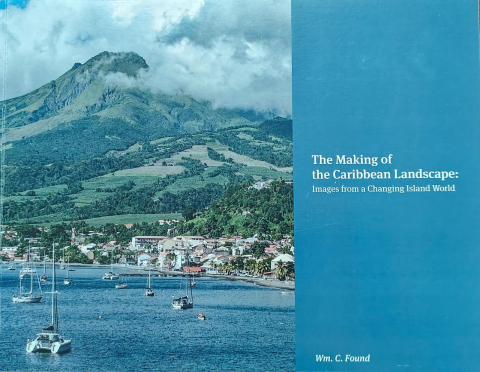
Prof. William Found, Emeritus Professor of York University donated two copies of his recent book ‘The Making of the Caribbean Landscape:Images from a Changing Island World’ to The Map and Image Library of the Department of Geography and Geology and The University of the West Indies Main Library. The book is dedicated in memory of Prof David Barker (1947-2022) from the Department of Geography and Geology, The University of the West Indies, Mona) and Dr. Karl Watson (1944-2025) from the Department of History and Archaeology, The University of the West Indies, Mona and Cave Hill Campuses for their contributions to the understanding of Caribbean landscapes.
The book represents the culmination of 60 years of research in the Caribbean, and is the first volume to analyse landscapes of the entire insular Caribbean from prehistoric times to the present. It is based on the analysis of almost 600 original photographs and maps produced over six decades. The research was undertaken in collaboration with several Caribbean organizations throughout the region, with particular focus on the Mona and Cave Hill campuses of the University of the West Indies; The University of Puerto Rico; The Institute of Ecology and Systematics, Cuban Academy of Sciences; archaeologists from the French and Dutch islands; and many Government and non-Government organizations. The author is deeply indebted to the thousands of individuals who have been of assistance over the years, and to the many organizations who have provided funding (McMaster, Florida, York, Umeå, Harvard Universities; IDRC, Canada Council, SSHRC, CIDA, and IUCN). Special thanks to York University students, particularly those with Caribbean ancestry. The book is dedicated to the memory of two Caribbean scholars and great contributors to understanding the Caribbean landscape: David Barker (1947-2022) and Karl Watson (1944-2025), Professors at the University of the West Indies (Mona and Cave Hill campuses, respectively).
Originally published on the FST Website on 17 Jun, 2025

“Women in geography chart more than maps- they chart pathways toward understanding people, place, and possibility” (Unknown).This sentiment is well reflected in the accomplishments of Dr. Thera Edwards, whom the Faculty of Science and Technology proudly congratulates on her appointment to the Editorial Board of Geo: Geography and Environment - a prestigious, fully open-access journal published by the Royal Geographical Society (RGS) in association with the Institute of British Geographers (IBG). The RGS is a leading learned society and professional body for geography in the UK, founded in 1830.
Dr. Edwards, Lecturer and Map Curator in the Department of Geography and Geology, will be working with the journal to promote innovative research on environmental issues, climate change, and sustainability. Geo is a peer-reviewed international journal published by Wiley that is highly sought after by researchers. Academics and scholars choose Geo for publication based on its range of paper formats, rigorous standards and reputation for showcasing impactful research. Geo welcomes new, critical, and underrepresented ideas from leading scholars and emerging voices.
We're proud to see Dr. Edwards assume this leadership role and look forward to her continued contributions to the field of geography.
Originally published on the FST Website 08 Oct, 2025

An article published in 2025, “Note on the Provenance of the Neotype of Heterostegina depressa D’orbigny 1826 (Foraminifera)” authored by Dr. Thera Edwards and Emeritus Professor Edward Robinson, Department of Geography and Geology, Faculty of Science and Technology, The University of the West Indies, Mona provided a brief comment on the provenance of the original type material and subsequent neotypes of Hesterostegina depressa after the type material went missing. It is of significance as H. depressa is the type for the genus Heterostegina, a group of considerable biostratigraphic importance. Biostratigraphy is a branch of geology that uses fossils to determine the relative ages of rock layers and to correlate rock formations across different locations. It essentially involves using the fossil content of rocks to understand the sequence of geological events and the relative time periods in which they occurred to provide a framework for understanding the history of life on Earth and the geological events that have shaped our planet.
The remarks presented in the paper are intended to provide a background for the very basic description of the original locality of the lost types of the larger benthic foraminifer Heterostegina depressa d’Orbigny 1826, and to clarify the minor confusion surrounding the derivation of the source material used to establish the neotype of the species, which is the type for the genus Heterostegina d’Orbigny. The fossil representatives of the group are of significant biostratigraphic importance from the late Eocene to the Quaternary (Banner & Hodgkinson, 1991; Less et al., 2008; Torres-Silva et al., 2017; Mitchell et al., 2022). Further study of the St. Helena material at the NHM to identify the few disc-shaped foraminifera recorded by Colman is warranted to verify possible sources of dispersal, considering the reported lack of coral reef environments and remote location of St Helena.
Reference: Thera Edwards, Edward Robinson; NOTE ON THE PROVENANCE OF THE NEOTYPE OF HETEROSTEGINA DEPRESSA D’ORBIGNY (FORAMINIFERA). Journal of Foraminiferal Research 2025;; 55 (2): 233–236. doi: https://doi.org/10.61551/gsjfr.55.2.233.
Originally published on the FST Website June 17, 2025.

The tropical Atlantic Ocean and Caribbean Sea have been isolated from other tropical oceans for the past three million years since the closure of the connecting seaway by the formation of the Isthmus of Panama. The investigation of how tropical marine organisms are able to get from one ocean to the other since that closure is of considerable biogeographic interest.
The larger benthic foraminifera (LBFs) are a group of millimeter-sized shelled marine protists, harbouring symbiotic microalgae such as diatoms, that are commonly found in tropical coral reef communities. Like corals, they are environmentally confined to warm shallow tropical and subtropical waters. This control on their choices of habitat, as well as their small size and ease of collection make the LBFs useful proxies in the study of how invasive marine species are transported involuntarily, through attachment to ship hulls or through contamination of ballast water in modern commercial shipping.
There is abundant literature on the subject for the Mediterranean and Indo-Pacific regions, especially since the opening of the Suez Canal. However, there is very little published information on the importance of these dispersal mechanisms, as well as possible natural alternatives, such as transport by ocean currents or inadvertent transport by attachment on other pelagic organisms like migratory fish, in the pre-1850 era of sailing ships and earlier historical times.
Emeritus Professor Edward Robinson and Dr. Thera Edwards, Department of Geography and Geology, Faculty of Science and Technology, The University of the West Indies, Mona examined the likely constraints and vectors controlling the invasion of recent cosmopolitan foraminifers from the Indo-Pacific region to the Atlantic and Caribbean using the species _Heterostegina depressa_ as a test case. This species originally evolved in the Indo-Pacific but was first described in 1826 from St Helena, a remote island in the South Atlantic, before the Suez and Panama Canals were opened. The authors provide reasons for discounting an invasion through natural range expansion or ocean currents along the possible routes available around South America or South Africa due to low temperatures and adverse ocean currents. The authors hypothesise that anthropogenic vectors such as sailing ships were the only likely means of transport because of their relatively high speeds and non-reliance on ocean currents. They concluded that the invasion of the Atlantic by _H. depressa_ was accomplished within the Little Ice Age (1350-1850 C.E.) when trans-Atlantic shipping first started to populate what had previously been an ocean devoid of shipping, between the start of Portuguese marine trade via South Africa with East Africa, India and the Far East in 1497 and the first description of _H. depressa_ in 1826.
The authors’ hypothesis is potentially applicable to other foraminifers as well as other biota currently resident in the ACR. Their model provides well defined parameters that can be tested using methods such as isotopic dating of foraminiferal assemblages or associated sediments.
Reference: Robinson, E.; Edwards, T. Invasion of the Atlantic Ocean and Caribbean Sea by a Large Benthic Foraminifer in the Little Ice Age. Diversity 2025, 17, 110. https:// doi.org/10.3390/d17020110
Originally Published on the FST Webiste June 17, 2025.

In a ground-breaking achievement for Caribbean academia, Professor Simon Mitchell of the Department of Geography and Geology is the 2023 recipient of the 2023 W. Storrs Cole Memorial Research Award by The Geological Society of America (GSA). This marks the first time that a scholar from the Caribbean region has received this award. Prof. Mitchell, an outstanding researcher was recognized for his significant contributions to the field of Sedimentary Geology. The award includes a research stipend.
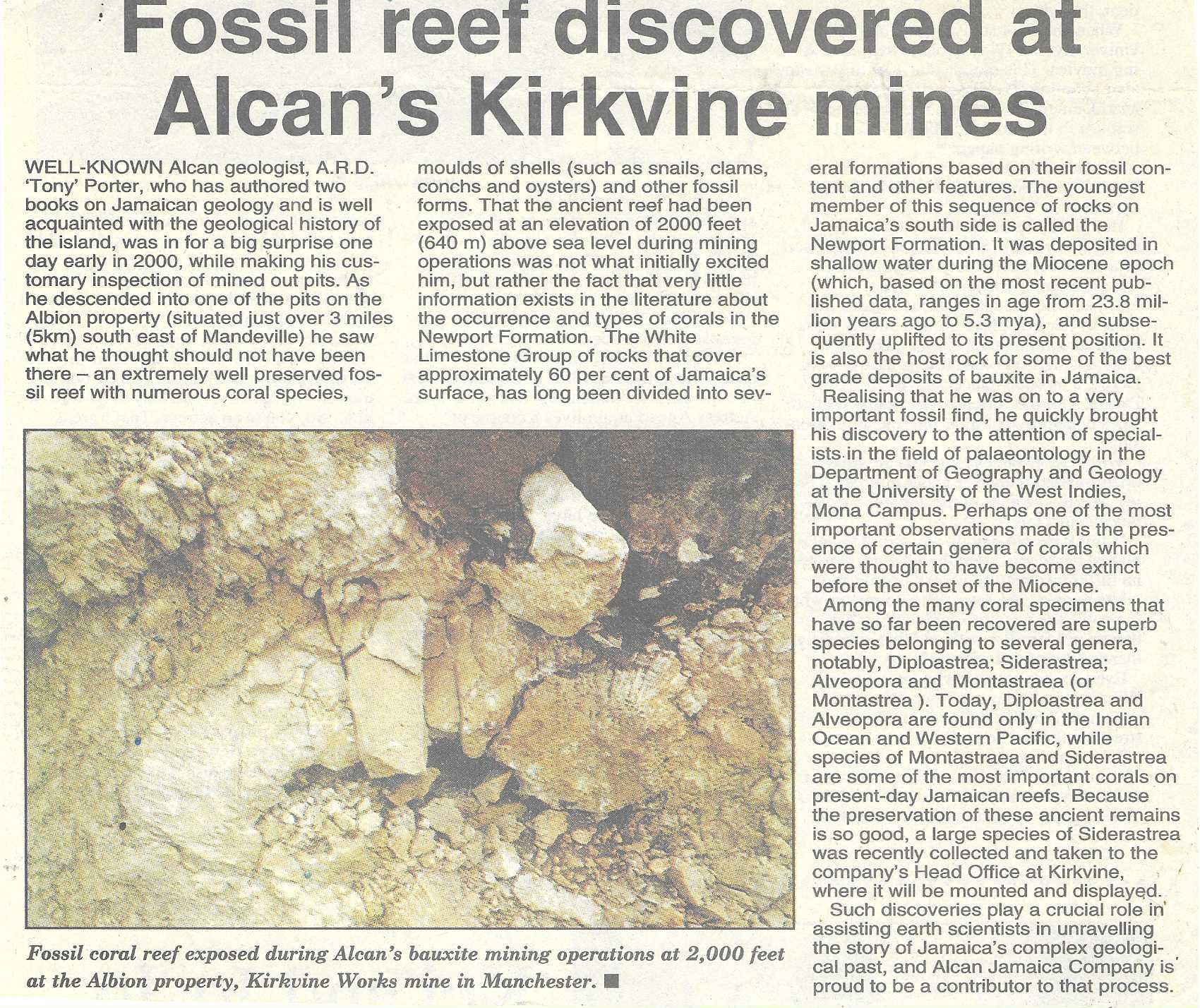
Twenty three years ago specialists in palaeontology from UWI visited a mine site with a fossil reef at Alcan Kirkvine Works several times to research, record and collect specimens, before the pit was reclaimed. Reclamation was a requirement under the mining law.
Our 7 faculties and 12 professional schools offer more than 200 programmes to some 18,000 graduate, undergraduate and continuing studies students.
The UWI, Mona ranks first in Jamaica among accredited tertiary-level programmes. In 2012, the University was again one of Jamaica’s Top 100 Employers.
© Copyright 2014-2026 | Disclaimer | Privacy Statement