


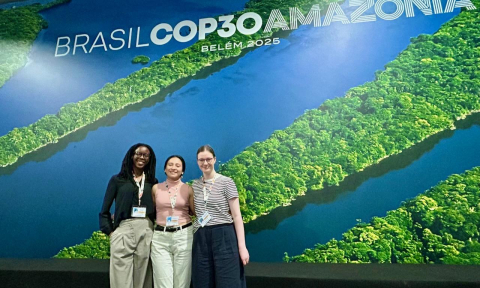
It has been three weeks since I attended COP30 in Belém, Brazil, and I am still processing the experience as I write this piece. Before I share highlights from what was both informative and intense, I want to explain why the decision to attend meant so much to me.
The confirmation of my participation as a WCC youth delegate arrived on 27 October - just hours before Hurricane Melissa struck Jamaica. By morning, the island I knew was unrecognisable. The silence after - no photo captures that. That reality made the trip to Belém conflicted. Should this opportunity have gone to someone more experienced, someone who could do more?
Yet, in those moments of doubt, I was reminded of God's perfect timing.
Carrying survivor's guilt, I landed in humid Belém at the start of COP30's second week, thinking this feels like a typical August in Kingston. My first day began with the United Nations Framework Convention on Climate Change Interfaith Liaison Committee dialogue. The message was clear: faith voices must be part of climate conversations, because churches, organisations, and ministerial bodies need to work together to navigate these challenges.
Climate change touches everything - energy, agriculture, water, and displacement. It needs all of us: scientists, farmers, faith leaders. The impacts don't hit everyone equally, but the solutions require everyone.
While my main focus going into COP30 was energy and agriculture, I quickly found myself absorbing much more across a variety of disciplines. Over five days, I attended more than ten side events, panels, and plenaries covering efforts to triple renewable energy capacity by 2030, increasing climate financing and adaptation, case studies on mitigation in energy and water, using national plans for resilience, and the role of small businesses in the just transition. The information was overwhelming - my notebook filled faster than I could process.
One phrase kept surfacing: mutirão, a Brazilian word meaning "collective effort." It perfectly embodied the spirit of COP30 - Indigenous leaders, government ministers, and grassroots organizers coming together to tackle a shared crisis. Speaking at the high-level segment on 18 November, I realized how faith communities can bring a grounded perspective to negotiations often dominated by hard technical and political language.
After pavilion visits, countless panels, and even an impromptu trip to the Green Zone, I left COP30 with a deeper conviction: the climate crisis knows no borders. It's more than rising temperatures or melting glaciers. It's a justice issue demanding collective action.
Looking back, I realise my doubts were misplaced. I was one voice among many, but together our voices embodied the resilience needed to turn commitments into meaningful action.
My hope is that readers carry forward the spirit of mutirão into their own communities.
Thank you to the WCC for the opportunity, and to my fellow faith-based delegates for making COP30 an unforgettable experience.
Published on 18 Dec, 2025

Our 7 faculties and 12 professional schools offer more than 200 programmes to some 18,000 graduate, undergraduate and continuing studies students.
The UWI, Mona ranks first in Jamaica among accredited tertiary-level programmes. In 2012, the University was again one of Jamaica’s Top 100 Employers.
© Copyright 2014-2026 | Disclaimer | Privacy Statement