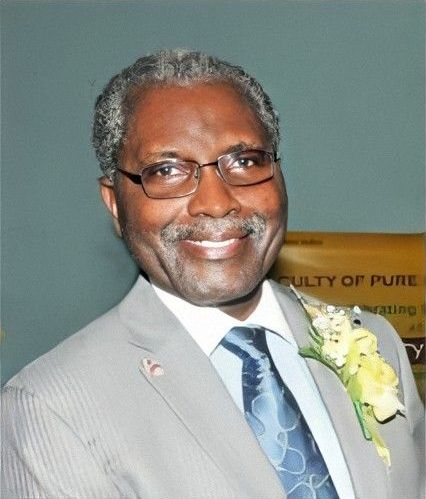
Professor Kahwa joined the staff of UWI in 1987. He established a laser laboratory which included powerful lasers, super-cold facilities and associated electronic and computational instruments needed to 'interrogate' and 'receive information' from novel molecules.
Professor Kahwa conducted extensive landmark work on the use, handling and disposal of hazardous materials such as asbestos in Jamaica. Through his work, both public and private sector companies have developed asbestos mananegment and removal processes and inventories of hazardous material and wastes. Professor Kahwa developed a new suite of BSc, MSc, MPhil and PhD programmes in occupational and environmental safety and health at UWI.
Prof. Kahwa continues to be active in public policy areas and was a part of the seven-member UWI Mona Strategic transformation Team given the responsibility of repositioning the UWI to face the challenges of the 21st century.
professor Kahwa has received numerous distinguished awards for excellence in research and public service, including the Gleaner Honour Ward for Science and Technology in 2003 and the Vice Chancellor's award for excellence in research and public service in 2004.
Prof Kahwa was appointed Dean of the Faculty of Pure and Applied Sciences in 2008