“Chemistry is not learned by memorising reactions, but by seeing, doing, and understanding how matter transforms.” Guided by this philosophy, a group of secondary school science teachers came together on January 7, 2026, to tackle one of the most challenging topics in the chemistry classroom—electrochemistry. Representing schools from across Jamaica, the nineteen (19) participants shared a common goal: to explore practical and engaging approaches that would make this complex subject more accessible to their students.
The workshop was hosted by the Department of Chemistry, Faculty of Science and Technology (FST), The University of the West Indies (The UWI), in collaboration with the University of Bologna (Italy), and in partnership with the Ministry of Education, Skills, Youth and Information (MoESYI). It was shaped by a clear and pressing need. Electrochemistry has long been identified by the Ministry as a particularly difficult area within the secondary school curriculum, largely due to its abstract concepts and the limited laboratory resources available in many schools. As a result, teachers are often required to explain key principles without the support of hands-on experimentation.

From the outset, the workshop sought to change this narrative through a carefully balanced blend of theory and practice. Coordinated by Dr Marvadeen Singh-Wilmot, Senior Lecturer in the Department of Chemistry, FST, The UWI, and Professor Lucia Maini, Professor of General and Inorganic Chemistry at the University of Bologna, with support from Dr Francine Taylor-Campbell, Education Officer for Chemistry in the Curriculum Unit at MoESYI, the session demonstrated that effective electrochemistry instruction does not require expensive or specialised equipment. Instead, teachers were introduced to safe, readily available materials that could be used to replicate core electrochemical experiments within the classroom.
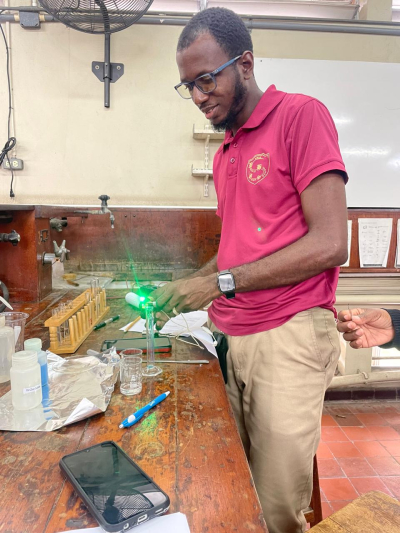
As theory met practice, abstract concepts began to take on tangible meaning. Participants actively engaged in interactive, hands-on activities that emphasised learning by doing. The atmosphere was one of curiosity and collaboration, as teachers tested methods, exchanged classroom experiences, and reflected on how these strategies could enhance student engagement and understanding.
By the end of the workshop, participants were equipped with practical skills and innovative teaching approaches that better prepare them to deliver electrochemistry lessons that spark curiosity, encourage experimentation, and deepen conceptual understanding. The workshop was made possible through grant funding from the University of Bologna Global South Programme, highlighting the impact of international collaboration in strengthening science education locally.