


The IAEA has launched its first Postgraduate Educational Course (PGEC) on Radiation Protection and the Safety of Radiation Sources for Caribbean countries, marking an important milestone in strengthening radiation safety capacity across the region.
The inaugural cohort includes eight women and four men from Belize, Guyana, Jamaica, Saint Kitts and Nevis, Saint Lucia, and Trinidad and Tobago. The course will help to establish a sustainable network of radiation safety professionals across the Caribbean.
The objective of the PGEC is to equip participants with the knowledge and practical skills needed to protect people and the environment from the risks associated with ionising radiation and to ensure the safe management of radiation sources.
Although this is the first time the course has been delivered in the Caribbean region, it builds on a well-established training programme. Since its launch in Argentina in 1981, more than 2500 professionals from 137 countries have completed the course. In 2026, the PGEC will also be held in Algeria, Argentina, Belarus, Ghana, Jordan, Kenya, Malaysia and Morocco.
In many Caribbean countries, radiation safety expertise is concentrated among a small number of specialists. When these professionals retire, move to other sectors or leave the country, valuable expertise can be lost, creating gaps in national programmes and increasing the need for retraining.
Limited resources make it difficult to establish and maintain national training programmes, while the geographic spread of island States can make accessing expertise and professional development opportunities more challenging.
“Countries in the Caribbean region face structural constraints that make developing and sustaining competence in radiation safety particularly challenging,” said Amparo Cristobal, an IAEA Radiation Safety Specialist.
To help address these challenges, the IAEA is promoting a regional approach to capacity building.
“By pooling scarce expertise, harmonizing training efforts, and fostering professional networks across borders, Caribbean countries can collectively strengthen their radiation safety infrastructure more effectively than would be possible individually,” explained Cliff Riley, Director General of the Jamaican Hazardous Substances Regulatory Authority, the course co-organizer together with the International Centre for Environmental and Nuclear Sciences at the University of the West Indies (ICENS) and the IAEA.
Charles Grant, ICENS Director General, agreed: “This course represents far more than a training opportunity. It is an investment in the region's future capacity to safely and effectively utilise nuclear and radiation technologies in medicine, industry, research, agriculture, and environmental protection. By strengthening expertise in radiation protection and safety, we are helping to ensure that these technologies continue to deliver benefits to societies across the region while maintaining the highest standards of safety and security,” he said as he welcomed participants at the opening ceremony.
The course is being delivered in a hybrid format. A virtual component took place from 30 March to 29 May 2026, while the in-person phase is being held in Kingston, Jamaica, from 1 June to 25 September 2026.
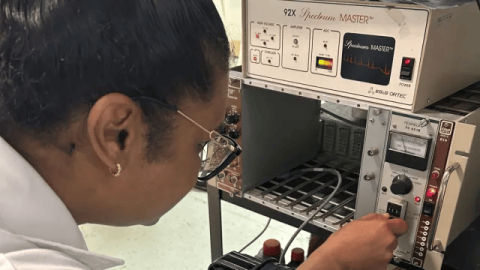
It combines lectures, practical exercises, laboratory sessions, demonstrations and technical field visits. Participants receive training in a broad range of topics, including radiation protection fundamentals, radiation measurements and quantities, biological effects of ionizing radiation, regulatory frameworks, assessment of external and internal exposures, medical and non-medical applications of radiation, emergency and existing exposure situations, and training methodologies.
“What I appreciate most about the course is its variety,” said Raquel Wilson, a Compliance Officer at the Regulated Substances Authority of Saint Lucia. “By covering so many topics, we are developing a deep understanding of the principles, practices and responsibilities that underpin the safe and effective use of radiation in medicine, industry and research,” she added.
A key component of the programme is the development of a practical work project. At the end of the course, each participant will present a specific radiation protection challenge in their home country and a plan to address it using the knowledge and skills gained during the course.
“This is actually my favourite part of the course,” said course lecturer Colleen Nattie, an Inspector in the Inspection and Enforcement Department of Jamaica’s Hazardous Substances Regulatory Authority and a participant in a previous edition of the course. “I love hearing how participants plan to apply their newly acquired knowledge and skills to address real radiation safety challenges in their home countries,” she added.
To ensure the long-term sustainability of the programme, the University of the West Indies, Mona, will assume responsibility for organising future editions of the course in collaboration with ICENS and HSRA.
“This will support continuity, encourage knowledge sharing, and contribute to the long-term development of competent national institutions throughout the region,” said Densil Williams, Principal of the University of the West Indies at Mona.
Saul Perez Pijuan, Head of the IAEA’s Latin America and the Caribbean Division, shared the long-term vision for this course. “We are proud to have launched the first PGEC designed specifically to address the needs of Caribbean countries,” said Perez. “It will help ensure that they are better prepared to manage radiation safely and effectively in the years ahead, and it represents a significant investment in regional cooperation, knowledge sharing and capacity building.”
Published on 14 Jul, 2026

Our 7 faculties and 12 professional schools offer more than 200 programmes to some 18,000 graduate, undergraduate and continuing studies students.
The UWI, Mona ranks first in Jamaica among accredited tertiary-level programmes. In 2012, the University was again one of Jamaica’s Top 100 Employers.
© Copyright 2014-2026 | Disclaimer | Privacy Statement