



On April 16, 2026, Ina Vandebroek, Professor of Ethnobotany at the Caribbean Centre for Research in Bioscience (CCRIB), Faculty of Science and Technology (FST) at The University of the West Indies, Mona, (The UWI Mona) delivered her Inaugural Lecture titled “Rooted in Relationships: Plants, People, and Culture in the Caribbean Biodiversity Hotspot.” The lecture drew on more than two decades of ethnobotanical research conducted across Jamaica, the Dominican Republic, and Caribbean diaspora communities in New York City.
Professor Vandebroek’s work examines how traditional plant knowledge remains both deeply rooted and dynamic, evolving as communities respond to urbanization, migration, and shifting health and socio-environmental conditions. She highlighted that people’s knowledge of plants is grounded in everyday life, shaped by practical needs related to health, food, and livelihoods. This knowledge includes a nuanced understanding of when, where, and how to harvest and manage plant resources.
Her lecture emphasized that ethnobotanical knowledge is far from anecdotal; instead, it follows identifiable patterns across communities. Rural populations tend to rely more heavily on native medicinal plant species, while family farmers serve as critical stewards of agrobiodiversity. These farmers also act as informal record-keepers, observing and responding to the impacts of climate change through adaptive practices.
In contrast, among Caribbean diaspora communities, plant knowledge often shifts toward familiar food plants that double as everyday medicines. These are commonly used to manage chronic conditions such as diabetes and asthma, demonstrating how cultural practices adapt within new environments while maintaining continuity.
Professor Vandebroek also addressed the ethical dimensions of ethnobotanical research, underscoring the importance of reciprocity and accountability to the communities who safeguard this knowledge. She encouraged a perspective that views the Caribbean as a biocultural landscape, one in which conservation, public health, and cultural heritage are inseparably linked.

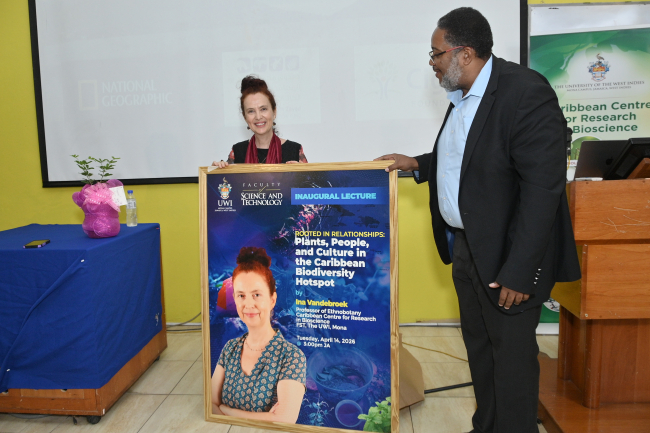
Photo caption 1: Prof. Vandebroek receiving a token from the Faculty, presented by Professor Michael Taylor, Dean, FST, The UWI Mona.
In addition to colleagues, family, and friends, the lecture was attended by several distinguished guests, including former Deans of the Faculty of Science and Technology, Professor Paul Reese and Professor Emeritus Ishenkumba Kahwa. Also in attendance were former Principal of The University of the West Indies, Mona, and Special Envoy for Climate Change, the Environment, Matters of the Ocean, and the Blue Economy, Professor Dale Webber, along with members of the Senior Management Team, including Professor Marvin Reid and Professor John Lindo.
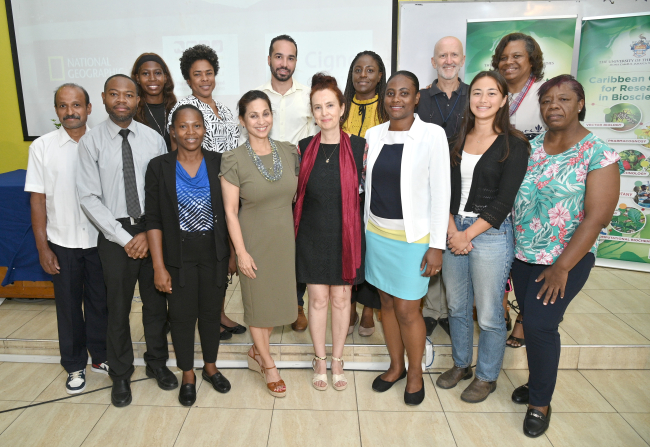
Photo caption 2: Prof. Vandebroek supported by her past and current CCRIB colleagues.
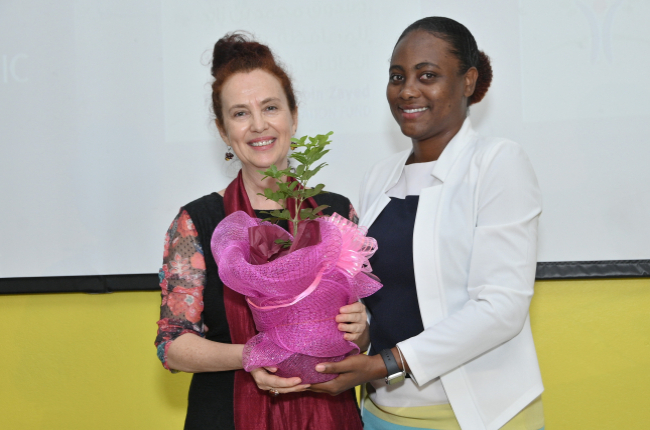
Photo caption 3: Prof. Vandebroek receiving a congratulatory gift, Lignum Vitae from her CCRIB colleagues, presented by Dr. Kimberly Foster.

Photo caption 4: Prof. Vandebroek exchange pleasantries with former Dean and Deputy Principal, The UWI Mona, Professor Emeritus Ishenkumba Kahwa.
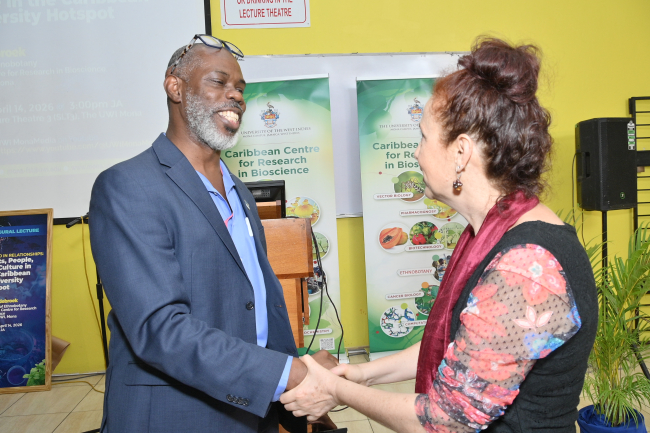
Photo caption 5: Prof. Vandebroek exchange pleasantries with Acting Principal, The UWI Mona, Professor Marvine Reid.
Members of the Faculty of Science and Technology (FST) Management Team were also present, including the Dean, Professor Michael Taylor. The event was further honoured by the presence of Ellen De Geest, Ambassador of Belgium to Jamaica.

Photo caption 4: Prof. Vandebroek shared lense time with Ellen De Geest, Ambassador of Belgium to Jamaica.
In addition, Professor Vandebroek’s former colleague, Michael Balick, Vice President for Botanical Science at the Center for Plants, People, and Culture at New York Botanical Garden, virtually extended his congratulations.
About Professor Ina Vandebroek
Ina Vandebroek is a Professor of Ethnobotany at The University of the West Indies, Mona, Jamaica. With over 25 years of experience, she has led and collaborated on research initiatives across Latin America, the Caribbean, and with Caribbean diaspora communities in New York City.
Her research focuses on understanding and strengthening the connections between cultural knowledge systems and Caribbean biodiversity. In Jamaica, her current projects centre on preserving culturally significant plant species and reinforcing traditional knowledge systems that support community health, food security, and local livelihoods. She is also actively involved in reassessing the conservation status of endemic Jamaican plants.
Professor Vandebroek’s scholarly contributions include four books, twelve book chapters, and over seventy peer-reviewed journal articles. Her work highlights the continued importance of wild and semi-domesticated plants in sustaining cultural heritage, even amid global biodiversity loss and transformations in traditional knowledge systems.
A key applied aspect of her research is the development of curricular materials and training programmes for healthcare providers. These initiatives aim to integrate the cultural knowledge, beliefs, and practices of Caribbean patients into healthcare delivery, fostering more culturally responsive and effective care.
She currently serves as Editor-in-Chief of Ethnobotany and Economic Botany, the flagship journal of the Society for Ethnobotany. Multilingual, she is fluent in Dutch, English, and Spanish, speaks Flemish at home, and actively champions Jamaican Patois as part of her commitment to cultural preservation.
Published on 30 Apr, 2026

Our 7 faculties and 12 professional schools offer more than 200 programmes to some 18,000 graduate, undergraduate and continuing studies students.
The UWI, Mona ranks first in Jamaica among accredited tertiary-level programmes. In 2012, the University was again one of Jamaica’s Top 100 Employers.
© Copyright 2014-2026 | Disclaimer | Privacy Statement